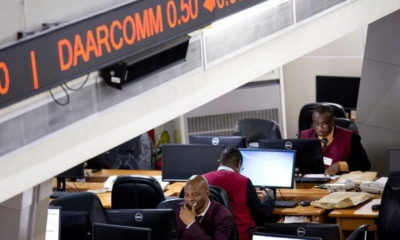
Nigeria’s equity market has undergone one of the most important revaluations in its history, expanding by more than ₦73 trillion since President Bola Ahmed Tinubu assumed office on May 29, 2023.
As of the close of trading on January 5, 2026, equity market capitalisation on the Nigerian Exchange (NGX) stood at ₦101,806,577,045,816.30, based on official exchange data. This represents a sharp increase from the ₦28.8 trillion market value recorded in the final trading sessions of May 2023.
The difference, ₦73.01 trillion, translates to a 253% expansion in market value in less than three years.
From ₦28.8 Trillion to ₦101.8 Trillion: A Structural Repricing of Nigerian Assets
In late May 2023, Nigeria’s equity market was characterised by subdued participation, thin liquidity, and cautious investor positioning. The All-Share Index hovered around the 52,000-point level, and market breadth frequently closed negative as investors waited for clarity on the direction of economic policy.
By contrast, as of January 2026:
-
The All-Share Index has risen above 159,000 points
-
Market capitalisation has crossed ₦100 trillion
-
Trading activity and participation have broadened across sectors
-
Equity valuation has more than tripled
This shift reflects not a short-term trading rally, but a structural repricing of Nigerian assets in response to major macroeconomic reforms.
Economic Policies That Rebuilt Investor Confidence
The scale of the market’s expansion is closely tied to policy decisions introduced under the Tinubu administration, many of which addressed long-standing distortions that previously undermined investor confidence.
Fuel Subsidy Removal and Fiscal Rebalancing
One of the administration’s earliest and most consequential decisions was the removal of fuel subsidies, a policy that had consumed trillions of naira annually and distorted public finances.
While the move initially triggered inflationary pressure, it fundamentally altered Nigeria’s fiscal outlook by:
-
Reducing recurrent consumption spending
-
Improving budget transparency
-
Creating fiscal space for capital expenditure and debt management
For capital markets, subsidy removal signalled policy credibility and fiscal discipline, two conditions critical for long-term investment decisions. Investors began to price Nigerian assets on future earnings potential rather than fiscal uncertainty.
Foreign Exchange Unification and Market-Driven Pricing
Another major turning point was the unification of multiple foreign exchange windows and the liberalisation of the naira. Prior to the reform, Nigeria operated a fragmented FX system that discouraged foreign investment due to uncertainty around pricing, liquidity, and repatriation.
FX convergence:
-
Reduced arbitrage opportunities
-
Improved transparency in asset valuation
-
Restored confidence in price discovery
As exchange-rate distortions narrowed, equities increasingly served as a hedge against currency risk, drawing both domestic and offshore capital into the stock market.
Inflation Re-Adjustment and Monetary Alignment
Although inflation spiked in the early phase of reforms, subsequent monetary tightening and fiscal discipline contributed to a gradual moderation in inflation through 2025, reshaping investor expectations.
As inflation expectations stabilised:
This environment supported higher equity valuations and sustained participation across banking, insurance, consumer goods, industrials, and healthcare stocks.
Improved Sovereign Perception and External Confidence
The administration’s reform agenda also reshaped Nigeria’s external perception. Commitments to market-oriented policies, fiscal consolidation, and FX transparency were recognised by global investors and credit assessors.
Improved sovereign perception:
-
Lowered perceived country risk
-
Encouraged re-engagement by institutional investors
-
Supported longer-term capital allocation into Nigerian assets
This shift played a key role in lifting overall market capitalisation.
Sectoral Re-Rating and Market Deepening
The rise in market value was further supported by:
-
Strong re-rating of banking and insurance stocks
-
Improved earnings expectations across consumer and industrial names
-
Capital raises, rights issues, and new listings that deepened market breadth
Rather than being driven by a narrow set of stocks, the expansion reflected broad-based participation and improved liquidity.
Why the Stock Market Matters as an Economic Indicator
The stock market is inherently forward-looking. The expansion to ₦101.8 trillion reflects how capital is pricing Nigeria’s future economic trajectory, not just present-day conditions.
While equity market growth does not immediately translate to lower living costs, it signals:
-
Confidence in policy direction
-
Expectations of improved corporate profitability
-
Willingness of capital to commit long-term
In this sense, the stock market has become one of the most reliable indicators of how investors view Nigeria’s reform path.
Sustainability and Risks
Despite the strong performance, sustainability will depend on:
-
Continued earnings growth
-
Inflation and interest-rate management
-
Regulatory consistency
-
FX stability and liquidity
Market corrections remain inevitable, but the magnitude of the revaluation suggests Nigeria’s equities have entered a new valuation regime, rather than a temporary surge.
Investors King’s Note
Nigeria’s equity market has expanded from ₦28.8 trillion at the start of the Tinubu administration to ₦101.81 trillion as of January 5, 2026, representing a ₦73 trillion increase in market value in under three years.
This transformation reflects the cumulative impact of fuel subsidy removal, FX unification, inflation re-adjustment, fiscal discipline, and improved investor confidence. More than any single policy, it is the consistency and direction of reforms that have reshaped capital market valuation.