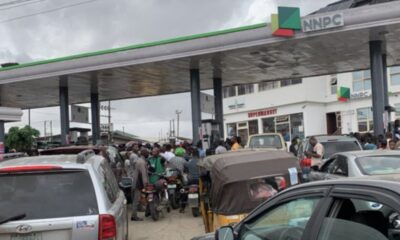
The Nigerian National Petroleum Company (NNPC) Limited reported petrol availability of just 54% across its retail stations nationwide in September 2026, despite generating N509 billion in profit after tax and N4.61 trillion in revenue during the month.
The figures, contained in NNPC’s September 2026 Monthly Operations and Financial Report released on November 3, highlight the contrast between the company’s financial performance and the availability of Premium Motor Spirit (PMS), commonly known as petrol, across its retail network.
According to the report reviewed by Investors King, NNPC Retail recorded 54% PMS availability, although the company did not explain the methodology used to calculate the figure or provide a comparison with the preceding month.
The disclosure raises questions about the effectiveness of the company’s petroleum distribution operations and whether its financial performance is translating into consistent product availability at its retail outlets.
While the 54% figure indicates limitations in reported petrol availability, it does not necessarily mean that 46% of NNPC filling stations were without petrol throughout September.
The report did not specify whether the indicator represented the proportion of stations with petrol in stock, average product availability over the reporting period or another internal operational measure.
It also provided no details on the number of stations assessed, the duration of any supply interruptions or the distribution of petrol availability across individual states.
These omissions make it difficult to determine the extent of the reported availability challenges or their direct implications for motorists.
Nevertheless, the figure is significant for a company that operates across Nigeria’s petroleum value chain, including crude oil production, natural gas operations, petroleum product trading and retail distribution.
NNPC’s reported N509 billion profit after tax represented approximately 11.05% of its N4.608 trillion revenue in September.
However, the published financial summary did not disclose how much of the revenue or profit came specifically from its retail business.
Consequently, the company’s overall profitability cannot be used to determine whether NNPC Retail operated profitably or whether its petroleum distribution activities improved during the period.
Beyond retail operations, the report showed that total hydrocarbon production increased to 3.04 million barrels of oil equivalent per day in September from 3.01 million barrels per day in August.
Combined crude oil and condensate production reached approximately 1.70 million barrels per day, while natural gas production rose to 7,789 million standard cubic feet per day.
Crude oil and condensate sales, however, increased marginally by 0.29% to 24.63 million barrels from 24.56 million barrels in August.
NNPC attributed the improvement in production largely to the restoration of output from Obodo Oil Mining Lease 150 and other producing assets.
The company also acknowledged persistent operational challenges, including equipment failures, flowline leaks, community protests, storage limitations and disruptions to export infrastructure.
Although these constraints affected upstream production, the report did not establish a direct connection between them and the 54% petrol availability recorded at NNPC Retail stations.
This distinction is important because the availability of petrol at filling stations depends on several factors, including product procurement, distribution logistics, inventory management and retail operations.
Without more detailed information, it is not possible to determine which of these factors contributed to the reported availability level.
The company also disclosed that cumulative statutory payments reached N11.14 trillion between January and September 2026.
On infrastructure development, NNPC reported that the Obiafu-Obrikom-Oben gas pipeline’s River Niger crossing had been commissioned and operationalised, while the Ajaokuta-Kaduna-Kano gas pipeline had reached 95% completion.
Despite these developments, the September retail availability figure highlights an important area of NNPC’s operations that requires greater disclosure.
For consumers, the more immediate measure of performance is whether petrol is consistently available at retail outlets, rather than the size of the company’s consolidated earnings.
For investors and other stakeholders, the concern is whether NNPC’s financial performance is accompanied by measurable improvements in operational efficiency, distribution reliability and customer service.
Greater transparency regarding retail station coverage, stock availability, supply interruptions and regional distribution would provide a clearer assessment of the company’s performance in the downstream petroleum market.
NNPC stated that the production, sales and financial figures in its September report were provisional and subject to reconciliation with relevant stakeholders.
The 54% PMS availability indicator remains one of the report’s notable operational disclosures, particularly given the absence of sufficient supporting data to explain its calculation and implications.