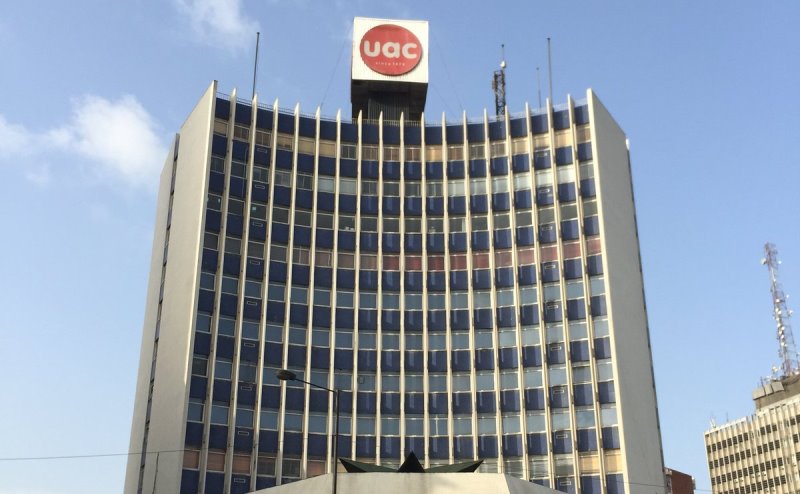
UAC of Nigeria (UACN) PLC reported a sharp surge in financial performance for the first quarter (Q1) ended March 31, 2026 with revenue and profit expanding more than threefold.
The group posted revenue of ₦191.22 billion, up 241.5 percent from ₦56.00 billion in Q1 2025, one of the strongest quarterly growth rates in recent years.
The increase reflects the full consolidation of C.H.I. Limited following its acquisition from The Coca-Cola Company in October 2025, alongside organic growth in packaged food, beverages, and paints.
Gross profit rose to ₦54.81 billion from ₦14.26 billion with gross margin expanding to 28.7 percent from 25.5 percent, supported by improved pricing strategies, procurement optimisation, and a stronger contribution from higher-margin segments.
Operating profit climbed to ₦28.40 billion from ₦6.83 billion, while operating margin improved to 14.8 percent.
However, operating expenses surged 230.9 percent to ₦26.86 billion, driven primarily by the integration of C.H.I.’s cost base.
Profit before tax increased significantly to ₦22.59 billion from ₦5.04 billion, while profit after tax rose 311.4 percent to ₦13.64 billion.
Earnings per share jumped to 449 kobo from 106 kobo, reinforcing the scale of earnings expansion.
Despite the strong headline numbers, underlying pressures are emerging.
Net finance cost rose sharply to ₦6.49 billion from ₦2.09 billion, reflecting higher borrowing costs associated with the acquisition.
Notably, the group disclosed that this figure was partially offset by a ₦6.8 billion one-off foreign exchange gain, indicating that core finance costs may be structurally higher than reported.
This raises concerns about earnings sustainability, particularly in a high-interest-rate environment where refinancing benefits may not fully offset borrowing costs over time.
Segment performance highlights a growing concentration risk.
The Packaged Food and Beverages segment accounted for ₦161.09 billion in revenue, representing the bulk of group turnover following the consolidation of C.H.I. Limited.
The segment delivered strong profitability with profit before tax rising to ₦21.46 billion.
In contrast, other segments showed mixed performance as the Paints business recorded steady growth with revenue increasing 15 percent to ₦11.59 billion and profit before tax rising 37 percent.
However, the Edibles and Feed segment experienced a 31 percent decline in revenue to ₦17.95 billion due to pricing pressures and weaker volumes.
The Quick Service Restaurants segment remained loss-making, posting a ₦317 million loss before tax, although this represents a modest improvement from the prior year.
From a financial position standpoint, leverage metrics improved. The group’s long-term debt-to-EBITDA ratio declined to 2.1x from 3.2x, while net debt-to-EBITDA improved to 3.5x from 5.9x, indicating better balance sheet management post-acquisition.
Free cash flow increased significantly to ₦34.57 billion from ₦14.38 billion, providing some comfort around liquidity and operational efficiency.
However, return metrics present a mixed picture. While annualised return on equity surged to 64.7 percent from 18.8 percent, return on invested capital declined to 32.1 percent from 45.1 percent, suggesting that the expanded capital base is yet to fully translate into efficient returns.
Critically, UAC of Nigeria PLC’s Q1 2026 results underscore a transformation story driven by acquisition-led growth. While the integration of C.H.I. Limited has significantly boosted scale, revenue, and profitability, it has also introduced higher financing costs and increased reliance on a single dominant segment.
For investors, the key question remains execution. Sustaining margin expansion, managing debt costs, and restoring balanced growth across all segments will determine whether the current momentum can be maintained beyond the initial post-acquisition boost.