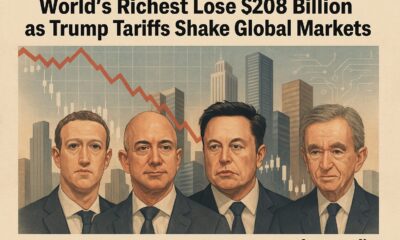
Global financial markets have created unprecedented wealth over the last two decades, but they have also destroyed it at a scale rarely matched in economic history.
Data from major market events shows that over $200 billion in billionaire wealth has been wiped out across a handful of high-profile collapses driven by leverage, liquidity crises, fraud exposure, and valuation resets.
These losses were not gradual. In several cases, fortunes built over years were erased in days or weeks, highlighting the structural risks embedded in modern financial markets.
The Scale of Wealth Destruction
A review of five major cases shows the magnitude of losses:
- Bill Hwang: ~$20 billion wiped out (2021)
- Sam Bankman-Fried: ~$26 billion lost (2022)
- Masayoshi Son: ~$70 billion decline (2000)
- Mark Zuckerberg: ~$100 billion drop (2022)
- Elizabeth Holmes: ~$4.5 billion wiped out (2016–2018)
Total estimated wealth destruction: over $220 billion
How Bill Hwang Lost $20 Billion in Days
The collapse of Archegos Capital remains one of the fastest wealth wipeouts in financial history.
Hwang used extreme leverage through total return swaps with global banks to build concentrated positions in a handful of stocks, including ViacomCBS and Discovery. At peak exposure, Archegos controlled positions estimated at over $100 billion, despite having far less underlying capital.
When stock prices declined, margin calls were triggered. Within 48–72 hours, forced liquidations by banks erased approximately $20 billion in personal wealth.
Major banks suffered billions in losses:
- Credit Suisse: $5.5 billion loss
- Nomura: $2.9 billion loss
Key issue: excessive leverage + concentration risk
How Sam Bankman-Fried Lost $26 Billion in One Week
At its peak, FTX was valued at $32 billion, and its founder Sam Bankman-Fried was worth $26 billion.
In November 2022:
- Reports revealed balance sheet weaknesses tied to Alameda Research
- A liquidity crisis triggered mass withdrawals
- FTX collapsed within days
Result:
- $26 billion fortune wiped out
- Over $8 billion customer shortfall
- One of the largest bankruptcies in financial history
Key issue: liquidity mismatch + misuse of customer funds
From $4.5 Billion to Zero: Elizabeth Holmes
Theranos reached a valuation of $9 billion with Elizabeth Holmes holding a stake worth $4.5 billion.
However:
- Technology claims failed verification
- Regulatory scrutiny intensified
- Investors pulled out
By 2018:
- Company dissolved
- Holmes’ net worth fell to $0
Key issue: fundamental failure + misrepresentation of technology
Masayoshi Son’s $70 Billion Loss
During the dot-com bubble, Masayoshi Son became one of the richest individuals globally.
At peak:
After the crash:
~$70 billion wiped out
The collapse was driven by:
- Overexposure to tech startups
- Collapse of internet valuations
- Market-wide correction
Key issue: valuation bubble + macro market collapse
Mark Zuckerberg’s $100 Billion Drop
In 2022, Meta Platforms stock declined sharply:
- Share price fell ~75% from peak
- Market cap lost over $700 billion at one point
- Zuckerberg’s wealth dropped by over $100 billion
Drivers:
- Heavy metaverse investment
- Declining ad revenue
- Rising interest rates impacting tech valuations
Key issue: strategic bets + macroeconomic tightening
What Went Wrong: Common Patterns Across Collapses
Despite differences in sectors, all cases share key risk factors:
1. Leverage
- Archegos amplified losses through borrowed exposure
2. Liquidity Risk
- FTX collapse triggered by inability to meet withdrawals
3. Overvaluation
- Dot-com bubble and Meta decline reflect pricing excess
4. Concentration
- Limited diversification increased downside exposure
5. Governance Failures
- Weak oversight accelerated collapse in multiple cases
Global Market Conditions at the Time
These losses did not occur in isolation. Each was linked to broader market dynamics:
- 2000 (Dot-com crash): Tech bubble burst globally
- 2021 (Archegos): Low interest rates encouraged leverage
- 2022 (FTX & Meta): Rising rates and tightening liquidity
- Theranos: Shift toward regulatory scrutiny in biotech
Markets tend to destroy wealth when:
- Liquidity tightens
- Valuations exceed fundamentals
- Confidence breaks
Lessons for Investors
1. Size Does Not Eliminate Risk
Even billionaires can lose everything.
2. Leverage Magnifies Losses
Returns increase — but so does collapse speed.
3. Liquidity Is Critical
If you cannot exit, you cannot survive.
4. Valuation Matters
Overpaying eventually leads to correction.
5. Governance and Transparency Are Non-Negotiable
Weak systems lead to systemic failure.
What This Means for Today’s Market
The next phase of global markets will likely continue to produce both extreme gains and extreme losses.
Key risks remain:
- High valuations in AI and tech
- Rising interest rate cycles
- Increasing use of leverage
- Rapid capital rotation
The lesson is clear:
Wealth creation in modern markets is fast, but wealth destruction is faster.
Investors King Notes
The destruction of over $200 billion in billionaire wealth is not just a story of individual failure. It is a reflection of how modern financial systems operate under pressure.
Markets reward risk-taking during expansion cycles but penalise it aggressively when conditions shift. The difference between long-term success and sudden collapse often comes down to discipline, diversification, and risk management.
For investors, the message is simple:
Surviving the market is more important than chasing it.