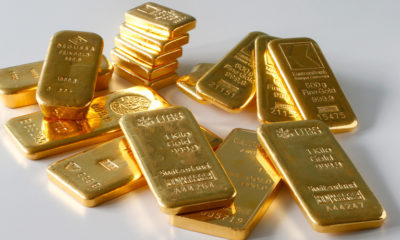
Gold prices advanced sharply on Wednesday as investors increased allocations to safe-haven assets amid renewed geopolitical tensions and mounting policy uncertainty in the United States.
Spot gold rose 2.4 percent to $5,057.50 per ounce by mid-morning GMT, building on Tuesday’s 5.9 percent jump.
The move lifted bullion decisively above the psychologically important $5,000 threshold, reinforcing gold’s status as a preferred hedge during periods of market stress.
On the futures market, U.S. April gold contracts climbed 3 percent to $5,080.90 per ounce, reflecting continued demand from institutional investors repositioning portfolios in response to heightened risk.
Market participants cited a convergence of geopolitical and monetary factors driving the renewed inflows. Tensions between the United States and Iran escalated after the U.S. military confirmed it had downed an Iranian drone that approached the USS Abraham Lincoln in the Arabian Sea, an incident that occurred amid diplomatic efforts to revive nuclear talks between both countries.
At the same time, concerns over U.S. monetary policy independence added to investor unease. President Donald Trump publicly stated that an investigation into Jerome Powell, chair of the Federal Reserve, should be pursued fully, reigniting debate over the central bank’s autonomy.
Analysts said the comments introduced an additional risk premium into financial markets, benefiting non-yielding assets such as gold.
The latest advance represents a strong rebound after bullion briefly slid to around $4,403 earlier in the week, following one of the sharpest two-day sell-offs in decades. That decline was triggered by a combination of heavy margin increases by the CME Group and market reactions to Washington’s announcement of a new Federal Reserve leadership nominee. Gold has since recovered those losses and is now up more than 17 percent year-to-date.
Investors are also assessing the outlook for U.S. interest rates. Attention later in the day is expected to focus on the ADP private payrolls report, a key indicator for labour market conditions and the future policy path of the Federal Reserve.
Market pricing currently suggests expectations for at least two rate cuts in 2026, a scenario that historically supports higher gold prices.
Non-yielding bullion typically benefits in lower-rate environments, as the opportunity cost of holding gold declines relative to interest-bearing assets.
Analysts say that expectation, combined with geopolitical risk, has strengthened gold’s medium-term appeal.
Other precious metals moved higher alongside gold. Silver jumped 4.5 percent to $88.90 per ounce, rebounding from recent losses.
Platinum rose 3.4 percent to $2,284.71, while Palladium gained 4.9 percent to $1,818.25.
With volatility elevated across global markets, analysts expect safe-haven demand to remain a key driver of precious metals pricing in the near term, as investors continue to navigate geopolitical risk, policy uncertainty, and shifting expectations around global interest rates.