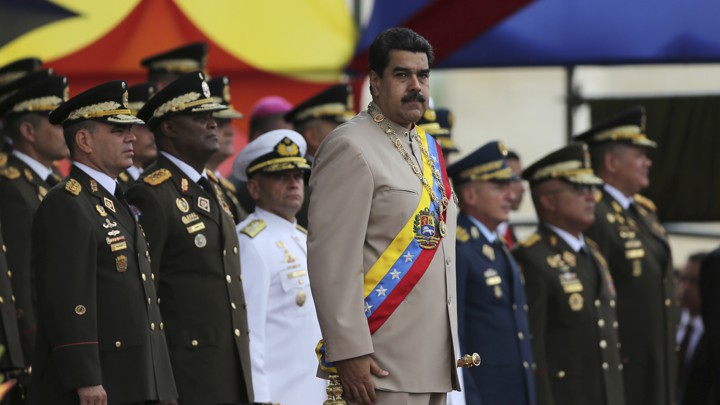
The arrest of Nicolás Maduro, the long-serving president of Venezuela, by United States forces on 3 January 2026 has shocked global capitals, rattled diplomatic norms, and raised urgent questions about sovereignty, law, and the future of Latin America.
The dramatic operation, involving airstrikes, elite military units, and the transportation of Maduro and his wife to U.S. custody, represents one of the most consequential foreign interventions in recent history.
Background: Who Is Nicolás Maduro?
Maduro succeeded Hugo Chávez in 2013 and presided over a decade marked by economic collapse, hyperinflation, political repression, a humanitarian exodus, and deep polarization in Venezuela.
His 2025 inauguration for a new term was met with widespread international criticism over electoral credibility and democratic legitimacy.
For years, the United States accused Maduro’s government of involvement in drug trafficking, narco-terrorism, and corruption, culminating in a federal indictment in New York that sought his arrest and prosecution.
The Operation: How Maduro Was Captured
In the early hours of 3 January 2026, under Operation Absolute Resolve, the U.S. military launched coordinated air and special operations strikes in and around Caracas, Venezuela’s capital. Elite units, including Delta Force and other special operations elements, seized President Maduro and his wife Cilia Flores before flying them to New York City to face charges in federal court.
The assault reportedly involved more than 150 U.S. aircraft from multiple service branches and was the result of months of planning and intelligence gathering.
Casualties on the ground in Venezuela were reported, alongside significant disruption in the capital area.
Maduro is currently being held at the Metropolitan Detention Center in Brooklyn, New York, and is expected to make a formal appearance in federal court in Manhattan on charges including narco-terrorism and drug trafficking, which he has denied.
Legal and Political Dimensions
U.S. Justification
The Trump administration characterized the operation as both a law enforcement action and a necessary response to alleged criminal conduct, citing indictments and sanctions previously issued against Maduro and associates. Some U.S. lawmakers defended the action, framing it as an effort to protect American citizens from drug trafficking and narco-terrorism.
President Donald Trump further announced that the United States would “run” Venezuela temporarily to ensure a stable transition and to manage the country’s vast oil resources, a claim that drew mixed responses even within Washington.
International Reaction and Geo-Political Stakes
Global reactions have been swift and polarized:
Strong condemnations came from major powers including China and Russia, both labeling the U.S. actions as violations of international law and Venezuelan sovereignty.
United Nations called the operation deeply troubling and suggested it could set a dangerous precedent. European leaders stressed the need to uphold international law and pursue peaceful solutions.
In Latin America, Brazil’s president called the intervention “an unacceptable line crossed,” while several regional governments criticized the use of force without multilateral approval.
Within Venezuela, the government quickly declared Vice-President Delcy Rodríguez as interim president, affirming continuity of state institutions despite Maduro’s absence.
Strategic and Legal Implications
Sovereignty and International Law
The capture of a sitting head of state by foreign military force raises profound legal questions. Under the United Nations Charter, unilateral military incursions into sovereign territory without consent or Security Council authorization typically violate international norms, a point underscored by legal scholars and foreign leaders alike.
Critics argue the operation undermines the rules-based international order and sets a precedent for extraterritorial law enforcement that other powers could exploit, destabilizing regional security and diplomatic norms.
Strategic Stakes
Venezuela sits atop one of the world’s largest proven oil reserves. Beyond legal debates, the operation’s timing and aftermath, including U.S. interest in oil infrastructure, have fueled speculation about economic motives intertwined with security objectives.
Regional Stability and Future Outlook
The aftermath of Maduro’s capture leaves Venezuela at a critical juncture:
-
Domestic governance: Interim leadership aims to hold the state together but faces political fragmentation.
-
Opposition dynamics: Some opposition leaders praised the capture as a turning point, while others cautioned against external control.
-
U.S.–Latin relations: The operation has strained relations with hemispheric partners and may reshape regional policy debates for years.
-
International law discourse: The case is already influencing global discussion on sovereignty, the limits of unilateral action, and how states pursue criminal accountability across borders.
The arrest of Nicolás Maduro is one of the most dramatic geopolitical events of the early 21st century. It combines criminal allegations, military force, contested legality, and geopolitical power plays in a single watershed moment.
As the world watches how Venezuela’s political transition unfolds, and how international institutions respond, the implications for global norms, regional stability, and U.S. foreign policy are only beginning to be understood.