Gold has captivated humanity for millennia, not just as ornamentation, but as a store of value, a safeguard against uncertainty, and a symbol of enduring worth.
Among modern gold investments, few hold the blend of prestige, reliability, and accessibility quite like the American Gold Eagle coins, the official gold bullion coin of the United States and a cornerstone of many diversified portfolios.
This article explores what makes this coin enduringly relevant for investors and collectors alike—not through hype, but through history, design, and practical utility.
The History Behind America’s Iconic Gold Coin
The American Gold Eagle was first issued in 1986 under the Gold Bullion Coin Act of 1985, signed into law by President Ronald Reagan. Its creation responded to a clear need: to offer U.S. investors a trusted, government-backed alternative to foreign bullion and private gold bars amid growing demand for tangible assets.
Unlike the pre-1933 U.S. gold coins (which were recalled during the Great Depression), the Gold Eagle was never intended for circulation—only for investment and collection. Since its debut, it has become one of the world’s most widely traded bullion coins, recognized for its consistency, authenticity, and U.S. government guarantee of weight and purity.
Design Features and Symbolism
The coin’s design is both artistic and deeply symbolic. The obverse (front) features Augustus Saint-Gaudens’ iconic 1907 depiction of Lady Liberty, striding forward with torch and olive branch, a vision of freedom and peace originally created for the $20 Double Eagle.
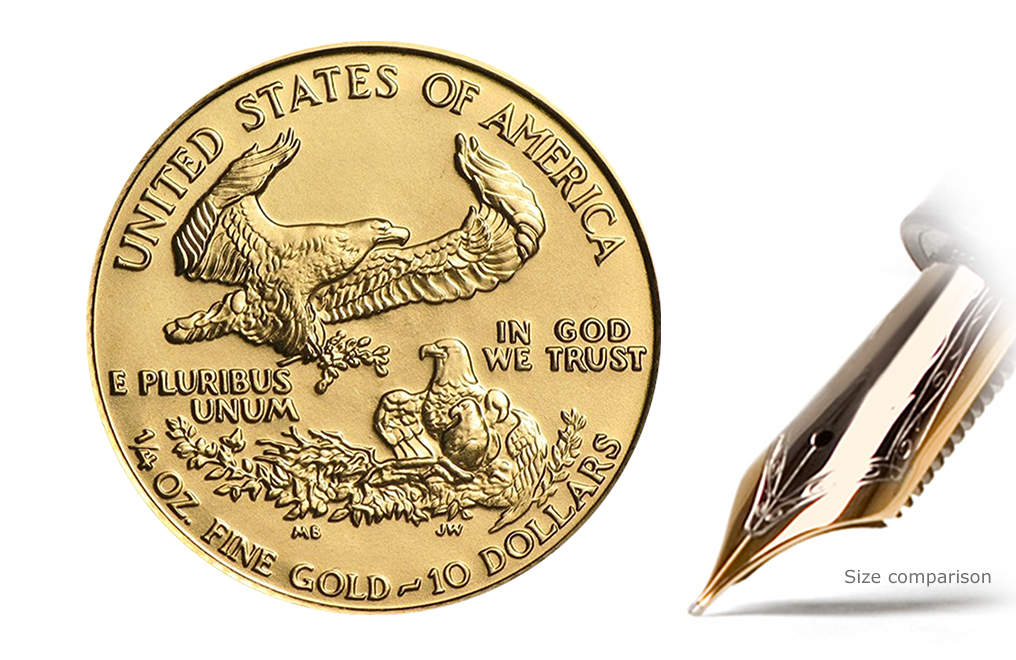
The reverse (back) shows a family of eagles: a male eagle returning to the nest with an olive branch, while a female guards her hatchlings. Designed by sculptor Miley Busiek, it represents protection, unity, and national resilience.
These motifs resonate beyond aesthetics: they connect modern investors to centuries of American monetary tradition and values. For collectors, subtle design variations across years (e.g., the 2021–present “enhanced” reverse) add historical nuance and collectible appeal.
Purity, Weight, and Denominations
American Gold Eagles are composed of 22-karat gold (91.67% pure), alloyed with silver and copper for enhanced durability—a practical choice that makes them more resistant to scratches and wear than pure 24-karat coins.
They are minted in four standard sizes, each with a legal tender face value (though their intrinsic gold value far exceeds it):
- 1 oz ($50 face value)
- ½ oz ($25)
- ¼ oz ($10)
- ⅒ oz ($5)
This range makes the coin accessible to investors at varying budget levels, whether you’re adding ounces over time or acquiring a full set for legacy purposes.
Why Investors Choose These Coins
Three key factors drive their enduring popularity:
- Liquidity: Gold Eagles are accepted globally by dealers, banks, and precious metals buyers—ensuring easy conversion to cash when needed.
- Government backing: Each coin is guaranteed by the U.S. Mint for weight, content, and purity—reducing counterfeiting risk.
- Durability: The 22-karat alloy strikes a balance between purity and practicality, ideal for long-term storage or physical handling.
For those seeking to hedge against inflation, currency devaluation, or market volatility, the Gold Eagle offers a tangible, portable, and historically resilient asset.
Comparing Bullion, Proof, and Burnished Versions
While all versions share the same gold content and design, they serve different purposes:
- Bullion: Struck for investment; matte luster, minimal packaging, lowest premium over spot gold. Ideal for wealth preservation.
- Proof: Mirror-like finish, frosted details, individually encapsulated with certificate of authenticity. Made for collectors; higher premium reflects craftsmanship and scarcity.
- Burnished: Satin finish, struck on polished blanks, with a distinctive “W” mint mark. Also collectible, often released in limited editions.
Most investors start with bullion; collectors may pursue proof or burnished sets for their aesthetic and numismatic value.
Storage, Authentication, and Buying Tips
- Storage: Use a dry, secure environment—such as a home safe, bank safe deposit box, or insured depository. Keep coins in protective capsules to prevent scratches.
- Authentication: Genuine Eagles have precise dimensions, sharp details, and correct weight. Reputable dealers provide assay verification, and the U.S. Mint offers public authentication guidelines online.
- Buying wisely: Purchase from established dealers with transparent pricing and return policies. Avoid deals significantly below market, too-good-to-be-true premiums often signal counterfeit risk.
Conclusion
The American Gold Eagle endures not because of fleeting trends, but because it fulfills a fundamental need: trusted, physical wealth that transcends digital systems and economic cycles.
Its blend of artistry, history, and metallurgical integrity makes it equally at home in a collector’s cabinet or an investor’s long-term strategy.
For those considering gold as part of a balanced financial approach, the Gold Eagle remains a rational, respected, and remarkably accessible choice—where tradition and practicality meet in 22-karat brilliance.