
Business News
The Poster that Dreams of You: Subconscious Marketing in Visual Design

Some billboards don’t merely promote — they recall. They look back at you on a subway wall, murmuring something unsettlingly familiar. Perhaps it’s the color of childhood, the shape of a face you’re not quite sure you know, or a skyline that suggests déjà vu. This is the eerie new frontier of subliminal marketing — where images don’t merely sell; they reflect.
In the age of AI-based creativity, brands are discovering how to design not from above, but from the inside out of the human mind. Campaigns are starting to seem strangely intimate, as though they were created from shards of the viewer’s own subconscious. 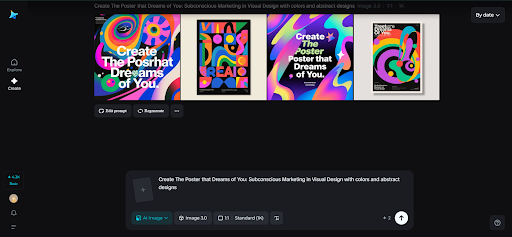
Applications such as Dreamina are making this dreamlike notion a reality, enabling designers to produce imagery that feels felt — and not just seen. And with the advent of the AI photo generator, posters are no longer still; they are shape-shifting mirrors of mood, memory, and longing.
Subconscious aesthetics: the emotional blueprint behind modern visuals
The most compelling campaigns no longer depend on product images or messaging — they depend on a sense of recognition. When individuals view a visual that reflects their inner world, they pause scrolling. They linger. And that’s where brands succeed.
This kind of design isn’t structured around demographics; it’s structured around psychographics — unconscious emotional codes that speak through atmosphere, not literal content. Today’s designers are employing AI software to test these sensory tongues:
- Color transitions that dissolve like half-forgotten dreams.
- Textures that are warm, nostalgic, or far-off.
- Symbolic elements — hands stretching out, doors ajar, clouds forming — that ask for emotional engagement.
Dreamina gives marketers and artists the power to shape these subconscious triggers with purpose, filling the gap between brand identity and personal connection.
Dreaming with Dreamina: building from the subconscious out
Dreamina is not merely a tool for creativity — it’s a partner in bringing emotion to image. When you work with its flow, you don’t merely create visuals; you call them forth. This is how you can unlock the process and create visuals that seem like they’ve already been somewhere in somebody’s memory.
Step 1: Write a detailed text prompt
Go to Dreamina and start with your text prompt — you can think of it as a psychic seed. The more sensory, emotional, and descriptive your prompt, the richer Dreamina can envision it. This is not a technical detail; it is tone, intention, and feeling.
For instance, you could write: A movie poster of an individual standing under an unstable neon sign on a rainy urban street, the puddles mirroring lost aspirations, a gentle sheen of blue and red merging into the evening atmosphere.
Dreamina will convert such poetic obscurity into graphics that are alive, intimate, and uncomfortably familiar — ideal for brands trying out unconscious narrations. 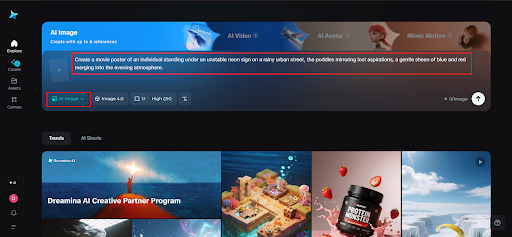
Step 2: Modify parameters and create
After preparing your prompt, modify your creative settings. Choose your model, set your aspect ratio (maybe a tall one for poster art or a wide one for immersive digital walls), and specify your size and resolution — Dreamina has 1K and 2K for detail and print suitability. When it all seems right, click the icon of Dreamina to create. The platform will understand not only your words, but the energy behind them — delivering to you versions that resonate with both surrealism and marketing acuteness.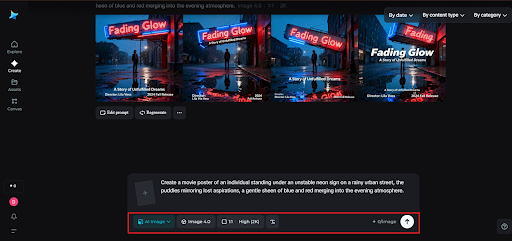
Step 3: Personalize and download
When your dreamlike picture shows up, you can polish it with the AI customization available in Dreamina. Apply inpaint to re-write visual pieces, expand to open up your scene’s narrative space, erase things that veer away from the essence of feeling with remove, or retouch textures until they whisper the correct emotion. When your visual truly gives you that strange ‘aha’ of recognition, simply tap on the Download icon to save your work. What you have created is more than a poster; it is more specifically a vessel of sentiment, printed in design.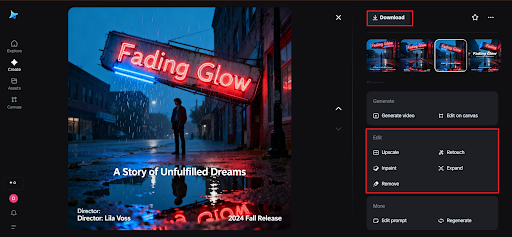
When visuals become mirrors
That’s why subconscious marketing has such a pull, because it’s not addressing audiences — it’s addressing through them. In this environment, AI technology is less about automating and more about amplifying intuition. Designers who used to rely on logical briefs are now being taught to work with chaos, allowing AI to capture the subtleties the rational mind might miss.
For instance:
- A brand can create imagery based on lucid dreams or repeat symbols from user narratives.
- Campaigns visually adapt based on audience emotion monitored in real-time.
- Art direction changes from the composition to the translation — demystifying mood and meaning in texture, color, and space.
This shift is creating a new creative paradigm in which AI serves as an emotional intermediary between brand and audience.
And in this liquid design universe, the AI logo generator is also evolving — generating identities that pulse, breathe, and change according to context. These responsive marks resonate with emotional realism instead of static depiction, further distorting the boundary between corporate identity and digital empathy.
Surreal strategy: what subconscious marketing really means
When a campaign is familiar, it engages affective trust — even though you can’t put your finger on why. That feeling of familiarity without recall is what subconscious design is striving for.
Advertisers leveraging tools such as Dreamina are finding ways to access this liminal space through:
- Symbolic abstraction: Applying repetitive symbols that audiences subconsciously link to emotion.
- Temporal blending: Blending retro and futuristic visuals to evoke timelessness.
- Emotive geometry: Delicate compositional hints that simulate a human pattern of perception.
The aesthetic is in the way that chaos turns into coherence — in how things that seemed random now seem inevitable.
And when those unconscious hints are polished, amplified, or re-mixed, Dreamina’s adaptive editing capabilities come alive. With capabilities modeled after Dreamina’s AI image editor, creators are free to create new realities unencumbered — tweaking emotional registers, blending dreams, and designing campaigns that operate outside the rational matrix of marketing.
The closing loop: when dreams become campaigns
In an age where all brands fight for milliseconds of attention, the strongest images are those that are personal, recognizable, and a little bit unreal. Subconscious marketing doesn’t just connect; it sticks — as if a song you can’t get out of your head or a dream you’re not even certain you had.
Dreamina provides contemporary storytellers with the ability to tap that magic responsibly — creating campaigns that aren’t only made for audiences, but made by them. The poster that dreams of you is no longer a fantasy; it’s a new creative reality that emerges where imagination and intelligence intersect.
With Dreamina, the subconscious has a favorite art director at last!